

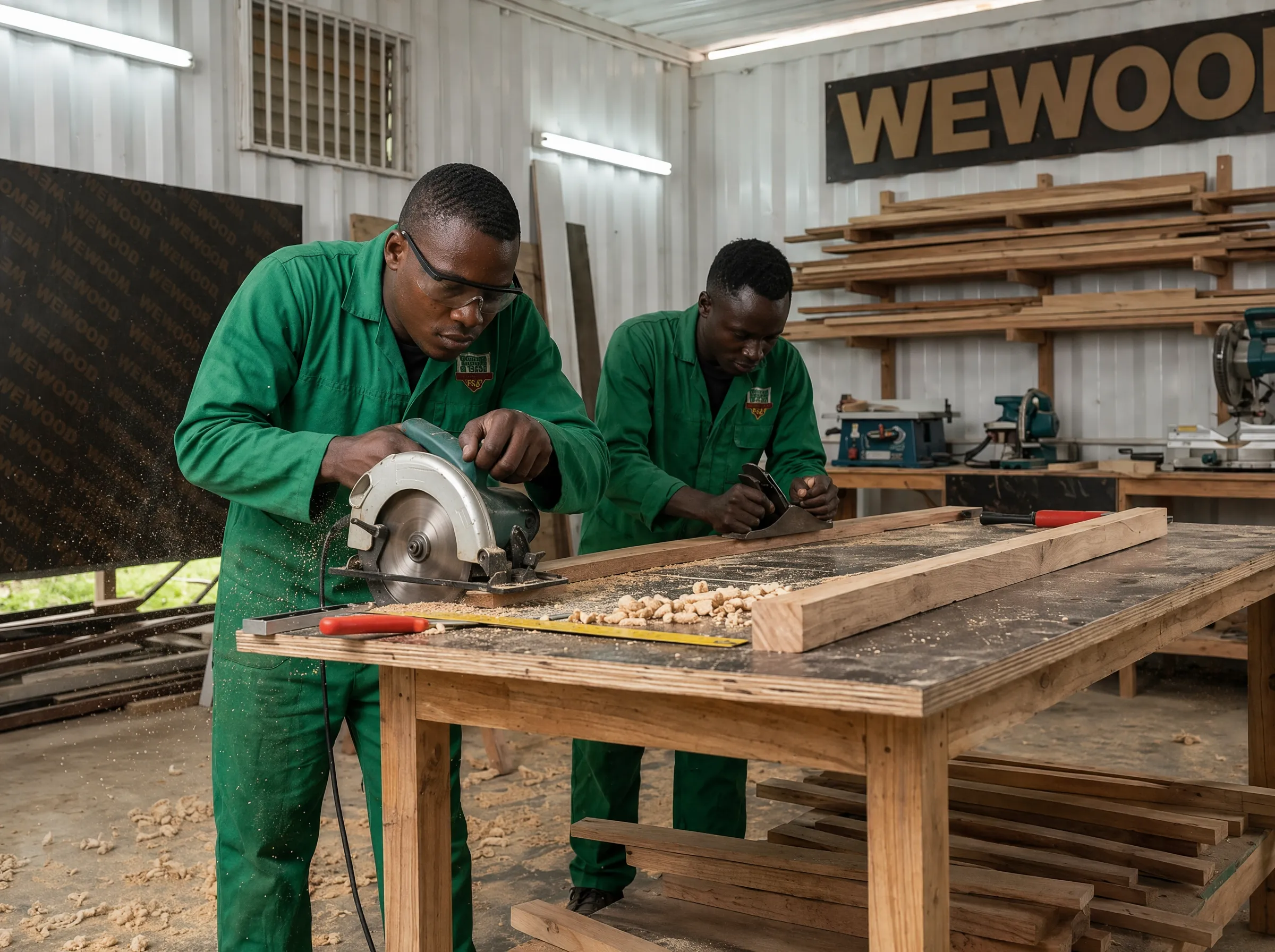
Walk into any timber market in Nigeria and you’ll notice something quickly: not all wood is created equal, and experienced carpenters don’t reach for the same type twice for every job. Choosing the right timber affects how long a piece lasts, how easy it is to work with, and how much a project ends up costing.
If you’re training as a carpenter or just curious about the materials behind the trade, here’s a breakdown of the wood types used by Nigerian carpenters most often, and what each one is best suited for.
8 Important Wood Types Commonly Used by Nigerian Carpenters and Their Uses
1. Iroko
Known as “Oji” in Igbo, Iroko is one of the most trusted hardwoods in Nigerian carpentry. It has a golden-brown color, interlocking grain, and strong natural resistance to weather and insects, which is why it’s often called Nigeria’s answer to teak. Iroko is generally easy to work with and holds nails and screws well, though its interlocking grain can make sanding a bit tiring.
Best for: Outdoor furniture, doors, windows, tables, chairs, and beds meant to last for years.
2. Mahogany
Mahogany is prized for its rich reddish-brown color and attractive grain, which develops a luxurious finish with proper polishing. It’s a dense, rigid wood, which means it doesn’t bend easily and can be tougher to cut and install compared to softer options. That extra effort is usually reflected in the premium price mahogany furniture commands.
Best for: High-end furniture, cabinetry, and decorative pieces where appearance matters as much as durability.
3. Obeche (Ayous)
Obeche, sometimes called African whitewood, is one of Nigeria’s most exported timber. It’s notably light in weight, pale straw-yellow in color, and has a naturally attractive silky sheen. On its own, it’s less durable than hardwoods like Iroko or Mahogany, so it typically needs proper treatment to resist insects and moisture.
Best for: Plywood, general joinery, drawer sides, mouldings, and lightweight furniture components.
4. Teak
Teak isn’t native to Nigeria but has been cultivated locally for decades and remains one of the most sought-after furniture woods worldwide. It has a warm golden-brown color with straight, uniform grain, along with excellent natural resistance to moisture and decay.
Best for: Outdoor furniture, boat-adjacent woodwork, and premium furniture pieces.
5. Gmelina
Gmelina is a fast-growing, widely available softwood in Nigeria, often chosen for its affordability and workability. It’s lighter and easier to cut and shape than dense hardwoods, making it popular for carpenters working on a budget or under time pressure.
Best for: General furniture, formwork in construction, and budget-friendly joinery projects.
6. Pine
Interestingly, pine isn’t grown commercially in Nigeria. Most pine timber enters the country as pallets used to transport imported goods. Despite being a softwood that scratches and dents more easily than local hardwoods, its appeal comes from arriving pressure-treated, well-planed, and kiln-dried, qualities that are harder to guarantee with some locally processed hardwoods.
Best for: Furniture making, shelving, and projects where easy cutting, carving, and turning matter more than maximum durability.
7. Sapele
Sapele is often used as a substitute for mahogany because of its visual similarity, so much so that it’s sometimes called “sapele mahogany.” It features a striking interlocking grain that darkens attractively with age, along with strong durability and rot resistance.
Best for: Furniture, veneers, wall panelling, and decorative joinery where a mahogany look is wanted at a more accessible price.
8. Mansonia
Mansonia is a lesser-known but valued hardwood, often used as a substitute for walnut in Nigerian carpentry. It has a smooth, fine texture and a grayish-brown color that finishes beautifully, making it a favorite for detailed cabinetry and interior joinery work.
Best for: Cabinet framing, interior joinery, and high-quality furniture requiring a refined finish.
Choosing the Right Wood Matters as Much as Skill
A common issue in the Nigerian timber trade is buyers being told they’re getting Iroko or Mahogany when a different, often weaker, wood is actually supplied. Part of becoming a skilled carpenter is learning to identify wood types accurately by grain, weight, and color, not just relying on what a seller tells you. Beyond wood choice, factors like proper seasoning, joint quality, and finishing all affect how long a piece of furniture or installation will last.
Final Wrap up: Learn to Work With Wood the Right Way
Knowing your timber is one of the most valuable skills a carpenter can have, and it’s something best learned hands-on, not just from a list. At Foci Skills Academy, our carpentry training program teaches you how to identify, select, and work with the wood types used by Nigerian carpenters every day, so you build real, marketable skills from your very first class.
If you’re ready to start a serious carpentry career in Abuja, visit Foci Skills Academy today to check our training schedule and enrollment details. Spaces are limited each intake, so reach out now before the next class fills up.